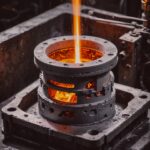

When heavy-industry equipment fails, the root cause is rarely “the whole machine.” It’s usually
a specific interface: a seal face, valve seat, sliding wear surface, or hot-zone component that
can’t survive heat, abrasion, corrosion, or thermal cycling.
That’s why the future isn’t ceramics replacing metals—it’s hybrid design: using metal for
structural strength and technical ceramics for the surfaces that take the punishment.
Key takeaways
- Metals are excellent for structural strength, impact tolerance, and overall toughness.
- Technical ceramics (e.g., alumina and zirconia) excel in wear resistance, high-temperature
stability, and chemical resistance. - Hybrid ceramic–metal assemblies often deliver the best uptime: metal supports the load,
ceramics protect the working surfaces.
Why metals struggle first in harsh industrial environments
Metals are the default in heavy industry for good reasons: they’re tough, ductile, and easy to
fabricate at scale. But many failure modes happen where metals are weakest:
1) High-temperature softening and distortion
As temperatures rise, many metals lose mechanical strength and become more prone to
deformation—especially at edges, seats, and sealing surfaces. Even small distortions can cause
leaks, loss of tolerances, and accelerated wear.
2) Oxidation and corrosion in aggressive media
In oxidizing atmospheres or corrosive process conditions, metals can pit, scale, or chemically
degrade. Once surfaces are compromised, equipment performance drops fast—especially in
valves, pumps, and flow-control systems.
3) Abrasive wear and particle erosion
In real plants, media often contains particles: dust, sand, slag fines, slurry solids, and other
abrasive contaminants. Metal surfaces can wear quickly, losing flatness and causing repeated
maintenance cycles.
Where technical ceramics outperform metals
Technical ceramics are engineered for extreme environments. The biggest value isn’t
theoretical—it’s practical: longer service life in the exact zones that cause downtime.
1) Wear resistance for sliding and sealing interfaces
Ceramics are typically much harder than metals, which makes them highly resistant to abrasion
and surface wear. That’s why ceramics are widely used for:
- seal faces
- valve seats
- wear rings
- liners and guides
- bearing and sliding elements (application dependent)
When wear resistance keeps surfaces flat and stable, you reduce:
- leakage
- vibration
- energy losses
- unplanned shutdowns
2) Chemical resistance where metals corrode
Many ceramic materials are highly resistant to aggressive chemical environments. This helps
maintain:
- surface integrity
- dimensional stability
- long-term sealing performance
This is especially valuable in industries with corrosive fluids, vapors, or oxidizing process
atmospheres.
3) High-temperature stability for hot-zone components
Ceramics maintain performance at temperatures that challenge many metals. In hot zones,
ceramics can provide:
- better dimensional stability
- heat resistance
- lower risk of deformation-driven failure
Typical heavy-industry areas where this matters:
- furnace/kiln fixtures and hot-zone parts
- foundry/casting environments
- thermal processing equipment
- high-temperature sealing and insulation interfaces
Alumina vs Zirconia: quick guidance
Two of the most common technical ceramics in industrial applications are:
Alumina (Al₂O₃)
Often chosen for:
- strong wear resistance
- good high-temperature performance
- broad industrial compatibility
Common applications include wear parts, insulating components, and hot-zone fixtures.
Zirconia (ZrO₂)
Often chosen for:
- strong wear performance
- applications needing enhanced toughness (relative to many ceramics)
- precision sealing components
Common applications include seal faces and components where durability and tight tolerances
matter.
Material selection depends on operating conditions (temperature, media, loading, tolerances).
The best approach is to select the ceramic grade based on the dominant failure mode.
The real answer: hybrid ceramic–metal design
In practice, the most reliable systems combine both materials:
- Metal provides the structure, mounting, impact tolerance, and overall load handling.
- Ceramic protects the surfaces exposed to heat, abrasion, or corrosive media.
Typical hybrid components in heavy industry
- Metal valve body + ceramic valve seat
- Metal pump housing + ceramic wear ring/liner
- Metal assembly + ceramic seal faces
- Metal support + ceramic hot-zone inserts/insulators
This hybrid strategy is often the fastest path to improved uptime because it targets the parts
that actually fail first.
How to decide: ceramics, metals, or hybrid?
Use this quick checklist:
Choose metals when:
- impact/shock loads dominate
- deformation tolerance is high
- environment is mild (low heat, low corrosion, low abrasion)
Choose technical ceramics when:
- wear/abrasion is the main failure mode
- chemical resistance is critical
- hot-zone stability is required
- surface flatness and sealing performance must hold over time
Choose hybrid when:
- the system needs metal’s strength and ceramics’ resistance at key interfaces
- downtime is driven by localized wear, leaks, or hot-zone damage
- you want an upgrade without redesigning the full machine
Conclusion: design for failure points, not tradition
Heavy industry is moving toward hybrid material design because it matches reality: metal is
ideal for structure, and ceramics are ideal for the harsh interfaces that cause wear, leaks, and
degradation.
If your equipment repeatedly fails at seals, valve seats, wear zones, or high-temperature
interfaces, a ceramic upgrade is often one of the highest-ROI improvements you can make.
Need help selecting the right ceramic material or designing a hybrid component?
Techceramic-M supports industrial teams with technical ceramics (including alumina and
zirconia) and precision components for demanding operating conditions.
Contact us to discuss your application, environment, and failure mode—and we’ll recommend a
practical material and component approach.